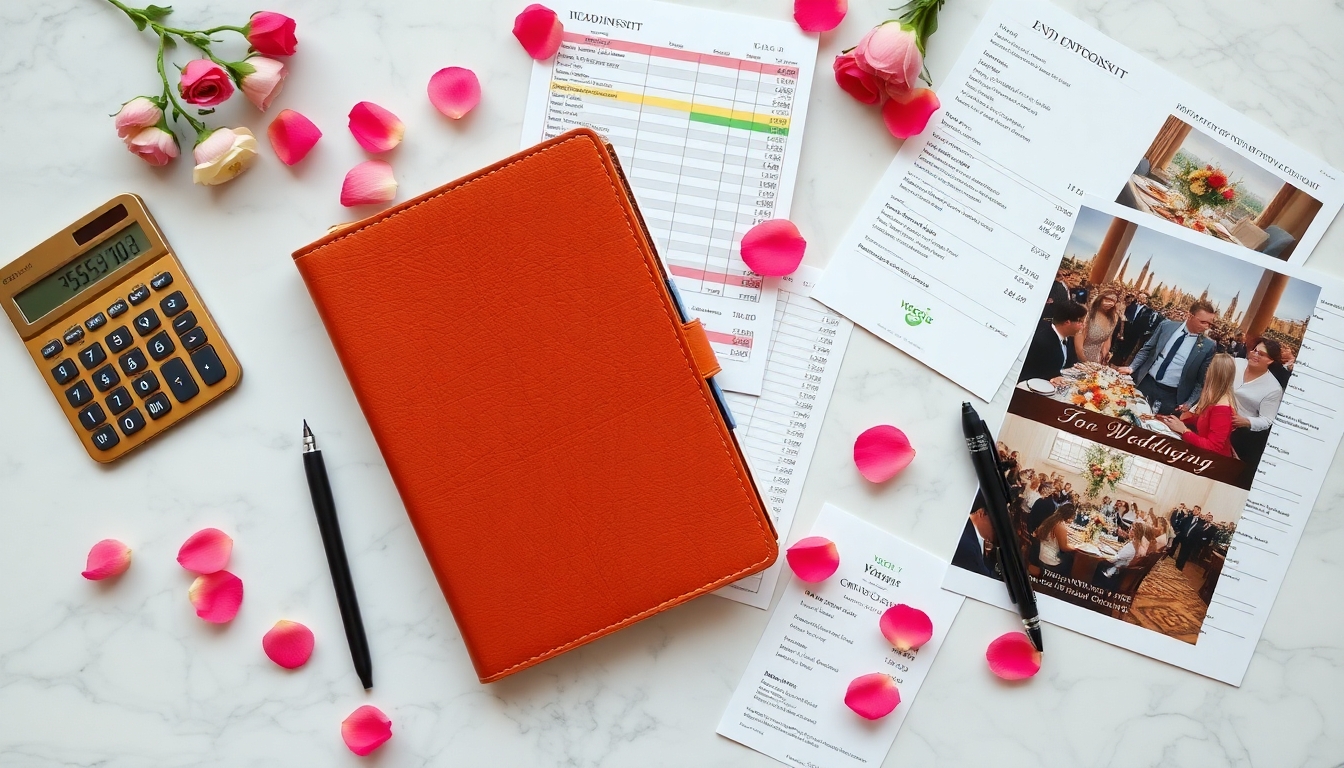
Your wedding day is a once-in-a-lifetime event — but creating the perfect celebration doesn't mean breaking the bank. With smart planning and clear priorities, you can have a beautiful wedding that fits both your vision and your budget.
This guide walks you through how to build a realistic wedding budget at any price point: where the money actually goes, how to save without anyone noticing, the hidden costs that derail couples, and concrete ideas for every budget from under $5,000 to $30,000 and up. When you're ready to put real numbers to it, our free wedding budget calculator turns this guide into a plan in a couple of minutes.
Creating your wedding budget: where to start
Before diving into vendors and venues, set a solid foundation. Almost every couple who overspends skipped one of these five steps:
- Determine your total budget. Add up your savings, what you can set aside each month before the date, and any contributions from family. Get to one honest number before you fall in love with a venue.
- Set your priorities. Talk with your partner about the two or three things that matter most — the food, the photos, the dancefloor — and agree to spend there and trim elsewhere.
- Research real costs in your area. Prices swing hugely by region. Our vendor cost guides — from venues to catering and photographers — give you grounded ranges to plan against.
- Track everything in one place. A spreadsheet or a dedicated tool keeps deposits, balances, and due dates from slipping through the cracks.
- Build in a buffer. Set aside 5–10% for the costs you can't predict. On a $30,000 wedding that's $1,500–$3,000 you'll almost certainly need.
Where the money actually goes: a real breakdown
Understanding how a typical budget is allocated helps you make informed trade-offs. The average US wedding runs about $34,200 for roughly 117 guests — close to $292 per guest (The Knot 2026 Real Weddings Study). Here's how that splits across categories, with the dollar figures at the national average:
| Category | Share of budget | At a $34,200 wedding |
|---|---|---|
| Venue & rentals | 27% | ~$9,200 |
| Catering & bar | 22% | ~$7,500 |
| Photography & video | 12% | ~$4,100 |
| Flowers & décor | 9% | ~$3,100 |
| Music & entertainment | 6% | ~$2,050 |
| Attire & beauty | 6% | ~$2,050 |
| Wedding bands | 5% | ~$1,710 |
| Planner / coordinator | 4% | ~$1,370 |
| Cake, stationery, transport & favors | 7% | ~$2,400 |
| Officiant & contingency | 2% | ~$680 |
| Total | 100% | ~$34,200 |
These percentages are a starting point, not a rule — venue and catering together eat nearly half the budget, which is exactly why guest count and venue choice move your total more than anything else. Sources disagree at the edges (bar and floral shares in particular), so treat the splits as guidance and adjust toward your priorities. The budget calculator applies any total you enter across these categories and reconciles the rest when you change a line.
Budget by guest count
Because so much of a wedding is priced per person, your guest list is the single biggest cost lever. A useful rule of thumb: a base of roughly $8,000–$12,000 in costs that barely change with size, plus about $100–$250 per guest on top.
| Guests | Wedding type | Typical all-in cost |
|---|---|---|
| 20 or fewer | Micro wedding / elopement | $5,000–$15,000 |
| 50 | Small wedding | $12,000–$22,000 |
| 100 | Mid-size wedding | $20,000–$35,000 |
| 150 | Large wedding | $28,000–$48,000 |
Every 50 guests adds roughly $8,000–$14,000. If your estimate is running high, the guest list is almost always the first place to look — a micro wedding sits at the bottom of this table for exactly that reason.
Cost-saving strategies for every budget
No matter your number, you can cut costs without sacrificing quality. The highest-impact moves:
- Marry off-peak. A non-Saturday date or an off-season month can save 20–40% on the venue alone — see our guide to weekday weddings.
- Trim the guest list. Each guest adds to catering, bar, rentals, and stationery. Cutting 25 people can save $2,000–$5,000.
- DIY selectively. Handle simple things yourself — favors, signage, centerpieces — but leave the load-bearing work to professionals.
- Choose an all-inclusive venue. Bundled packages are often cheaper (and far less stressful) than assembling individual vendors.
- Rent or borrow décor. Buy little, rent what you can, and resell anything you do buy afterward.
For a deeper list, see 10 clever ways to trim your wedding budget without sacrificing style.
Hidden wedding expenses to watch out for
The categories above are the obvious ones. The budget-busters are the line items that don't appear until the contracts arrive:
- Service charges and tax. Venues and caterers routinely add an 18–24% service charge plus sales tax. On a $15,000 food-and-venue bill that's $3,000–$4,000 you didn't see coming.
- Gratuities for vendors who don't build them into the contract — see how much to tip wedding vendors.
- Vendor meals. Most contracts require you to feed the photographer, planner, and band at per-head rates.
- Overtime. If the party runs long, photographer, DJ, and venue overtime can add hundreds per hour.
- Alterations — a dress often needs $200–$800 in alterations on top of the purchase price.
- Postage, the marriage license, and wedding insurance — small individually, easy to forget entirely.
Fold these into your plan from the start, and keep that 5–10% buffer so a single surprise doesn't force you to raid another category.
Budget-friendly wedding ideas by price point
Numbers are abstract until you can picture them. Here's roughly what each budget buys:
Under $5,000
- Host a backyard, park, or restaurant wedding with a small guest list.
- Opt for a brunch or cocktail reception instead of a full plated dinner.
- Use a beautiful wedding website and digital invitations.
- Choose a small display cake plus a sheet cake in the back.
$5,000 to $15,000
- Book an all-inclusive venue on an off-peak date.
- Limit the bar to beer, wine, and one signature cocktail.
- Use seasonal, local flowers and greenery as filler.
- Hire a DJ instead of a live band.
$15,000 to $30,000
- Book a full-service venue and a day-of coordinator.
- Upgrade your photo and video package.
- Add more elaborate floral arrangements and design details.
- Open beer/wine plus a signature drink for the whole reception.
$30,000 and up
- A sought-after venue, a live band, and a full open bar.
- Photo plus video, premium florals, and welcome or after-events.
- Guest extras: shuttle service, late-night food, welcome bags.
Not sure which tier fits you? The wedding style quiz matches your priorities to a realistic budget band in about a minute.
Tips for sticking to your wedding budget
Once your budget exists, these habits keep it intact:
- Track every expense. Log deposits, balances, and due dates as you go — not the week before.
- Get every cost in writing. Make sure contracts spell out service charges, overtime, and what's included, so nothing surprises you.
- Avoid impulse purchases. Sit on any unplanned expense for a day and check it against your total first.
- Stay flexible. When one category comes in high, decide immediately which other category gives — don't just raise the total.
- Watch the wedding markup. The word "wedding" can raise a quote; get prices both ways where it's fair to.
When to splurge and when to save
Knowing where to put your money is the whole game. Spend where guests notice and memories live; save where they don't.
Worth the splurge
- Photography and video — the one thing you keep.
- Catering and bar quality — guests remember how they were fed.
- Venue ambiance and guest comfort.
Safe to save
- Invitations and paper goods (go digital where you can).
- Favors — most are left behind.
- Transportation and over-the-top décor.
Use the right tools to manage it all
The right tools turn a stressful spreadsheet into a calm plan:
- Start with the wedding budget calculator. Enter your total and guest count and see a realistic split across every category, reconciled in real time as you edit.
- Keep a running tracker. Google Sheets or a planning app records every deposit and balance against your plan.
- Use digital payments with clear records, and read deposit and cancellation terms before you pay.
Frequently asked questions
How much should a wedding cost?
The average US wedding costs about $34,200 for roughly 117 guests — close to $292 per guest (The Knot 2026). But the average is skewed by expensive weddings; plenty of couples spend well under $20,000. The right number is the one you can comfortably afford, planned around your own guest count and region.
How do I create a wedding budget from scratch?
Start with one honest total (savings plus monthly saving plus any family contribution), agree on your top two or three priorities, research real local costs, track everything in one place, and set aside a 5–10% buffer. Then assign every dollar a job before you start booking.
What percentage of a wedding budget goes to the venue?
The venue and rentals are typically about 27% of the budget, and venue plus catering and bar come to nearly half (around 49%). Because it's the largest share, the venue is where smart choices — off-peak dates, bring-your-own catering — save the most.
How much should I budget per wedding guest?
Plan for roughly $100–$250 per guest all-in once you include catering, bar, rentals, stationery, and favors; the national average works out to about $292 per guest. Trimming the guest list is the fastest way to lower your total.
How much should I set aside for hidden wedding costs?
Keep a 5–10% buffer outside your category split. It absorbs the costs that hide in contracts — 18–24% service charges, sales tax, gratuities, vendor meals, overtime, and alterations — so one surprise doesn't force you to cut elsewhere.
Final thoughts: celebrate your love, not your spending
Your wedding is about celebrating your commitment, not the size of the bill. Anchor on your guest count and region, protect your top priorities, budget for the costs everyone forgets, and let the rest flex. That's how you get a day that feels generous and still leaves you starting your marriage out of debt.
Ready to put numbers to it? Build your plan with the wedding budget calculator, find more ways to save in 10 clever ways to trim your budget, or browse the full wedding budget guide.